
Once in a Blue Moon: The Science, Myths, and Magic Behind this Phenomenon

You’ve probably heard of the phrase: "That only happens once in a blue moon." and even used this phrase yourself. It is a saying we use when something rare happens, or almost never. like having a stroke of luck, or doing something you don't do, like dancing at a wedding, or a teenager emptying the dishwasher without being asked! Ha ha! Often used in a jovial way
Have you ever paused to wonder what a Blue Moon actually is? Or is it actually blue? (Spoiler alert: usually, no). How rare is it, really?
Let’s have a look at the science, history, and folklore behind this famous lunar event.

What is a Blue Moon, Anyway?
In modern astronomy, a Blue Moon doesn't refer to the color, it refers to its rarity, not its color. The phrase “once in a blue moon” dates back to 1528, when it described something absurd or impossible. Only centuries later did it evolve to mean “something rare.” Also becuase the human calendar doesn't perfectly align with the lunar cycle, we occasionally get an "extra" full moon.
The lunar cycle takes about 29.5 days to complete, but our human calendar months are 30 or 31 days long (except February), a mismatch occurs.
"
There are actually two distinct definitions of a Blue Moon:
1. The Monthly Blue Moon (Modern Definition)
This is the one most of us are familiar with. It occurs when two full moons fall within a single calendar month.
The moon takes about 29.5 days to complete a full cycle (from new moon to full moon and back). Since almost all of our months are 30 or 31 days long, it’s entirely possible for a full moon to hit on the 1st or 2nd of the month, leaving just enough time for a second full moon to squeeze in before the month ends.
2. The Seasonal Blue Moon (Traditional Definition)
This is the older, trickier definition. A standard astronomical season (Winter, Spring, Summer, Autumn) typically has three full moons. However, because of that same calendar mismatch, a season will occasionally have four full moons. When this happens, the third full moon of that four-moon season is officially designated as a Blue Moon.
The accidental mix-up: We actually owe the modern "two moons in a month" definition to a mistake! In 1946, an amateur astronomer writing for Sky & Telescope magazine misinterpreted the old Maine Farmers' Almanac (which used the seasonal definition). The mistake caught on, went viral (1940s style), and became the most popular definition used today.

Does the Moon Ever Actually Turn Blue?
Almost never—but it can happen under very specific atmospheric conditions.
For the moon to take on a genuinely blue tint, the Earth's atmosphere must be filled with microscopic particles that are slightly wider than the wavelength of red light (about 0.7 microns). When these specific particles are present, they scatter red light away while allowing blue light to pass through.
What causes this? Massive natural disasters.
The 1883 Krakatoa Eruption: When the Indonesian volcano erupted, it blasted so much ash into the stratosphere that people reported seeing blue and green moons (and vivid green sunsets) for nearly two years.
Forest Fires: Major, intense wildfires—like those in Western Canada in 1950—have occasionally created localized smoke plumes with just the right particle size to turn the moon blue across parts of North America.
So, if you look up and the moon is literally blue, don't look for a calendar—look for a nearby volcano or wildfire.
How Rare is "Once in a Blue Moon"?
If we go by the mathematical frequency of calendar Blue Moons, they aren't quite as rare as the idiom implies. On average, a Blue Moon happens once every 2.7 years.
February only has 28 days (or 29 in a leap year), it is physically impossible for February to ever have a monthly Blue Moon. In fact, about once every 19 years, February will have no full moon at all. When this happens, the surrounding months (usually January and March) will both end up with two full moons, resulting in a rare Double Blue Moon year.
The odd lengths are a leftover quirk from ancient Roman superstitions, because Romans believed even numbers were unlucky, they set the months to 29 or 31 days. February got left with 28 days simply because it was the last month of the year and had to take the remaining leftover days. Julius Caesar later added days to even out the 365-day year, but he left February at 28 days... Heard the traditonal :
"Thirty days hath September, April, June, and November. All the rest have thirty-one, except February alone, and that has twenty-eight days clear, and twenty-nine in each leap year"
The Cultural Magic of the Blue Moon
Human beings have always looked to the night sky to map out their lives, crops, and stories. Before the days of digital calendars, full moons were named to track the seasons (like the Harvest Moon or the Wolf Moon). As the Blue Moon didn't fit into the standard 12-month structure, it was seen as a bit of a wildcard.
In various folklore traditions, it became associated with:
A time for reflection: A bonus moon meant an extra opportunity to realign goals and let go of what wasn't working.
Heightened intuition: Many cultures believed the veil between the ordinary world and the spiritual world was a little thinner during an extra full moon.
Surprise and luck: Because it was an unexpected guest in the sky, it was often thought to bring unexpected opportunities.
Keep Your Eyes on the Skies
The next time you hear someone say "once in a blue moon," you can smile knowing the fascinating blend of accidental history, celestial mechanics, and atmospheric science that powers the phrase.
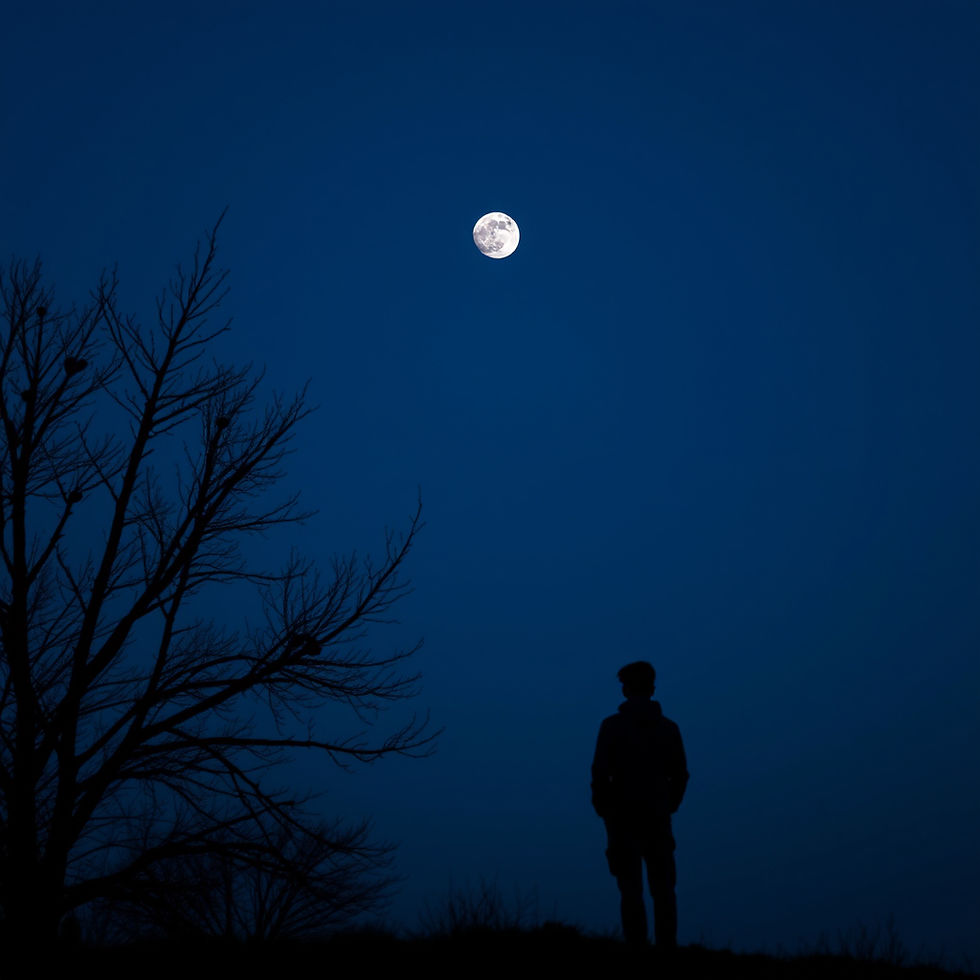
While it might not actually look sapphire blue, an extra full moon is always a great reminder to step outside, look up, and appreciate the beautiful, rhythmic clockwork of our universe.
One of our favourite places to view the moon and nights sky is in Imsouane in Morocco, where we host our Longboarding Surf & Yoga Retreats. We get the perfect uninterruptedview as the moon rises over the moutnains right infront of us over the bay, from our Surf Lodge, check out some of the views here.


Comments